The $600-a-Day Remote Job Was a Scam – Here’s What Gave It Away

I kept getting text messages offering remote jobs with pay up to $600 a day. Here’s how I identified the scam—and the FTC’s advice for avoiding it.
This spring, my phone started buzzing with an odd pattern of messages: "Work from anywhere," "Earn up to $600 a day," "Remote position available." The texts promised easy money but were strangely short on an important detail: what exactly was the job?
One text said the only qualification was being 22 years old. That oddly specific requirement was my first clue. Another invited me to reply "YES" if interested. The thing is, I wasn't job hunting. So why were they showing up?
They're part of a growing scam targeting people with fake work-from-home opportunities. Over the last three years, nearly 50,000 people reported employment scams to the Better Business Bureau's Scam Tracker, with reports doubling in 2025.
The texts are intentionally vague
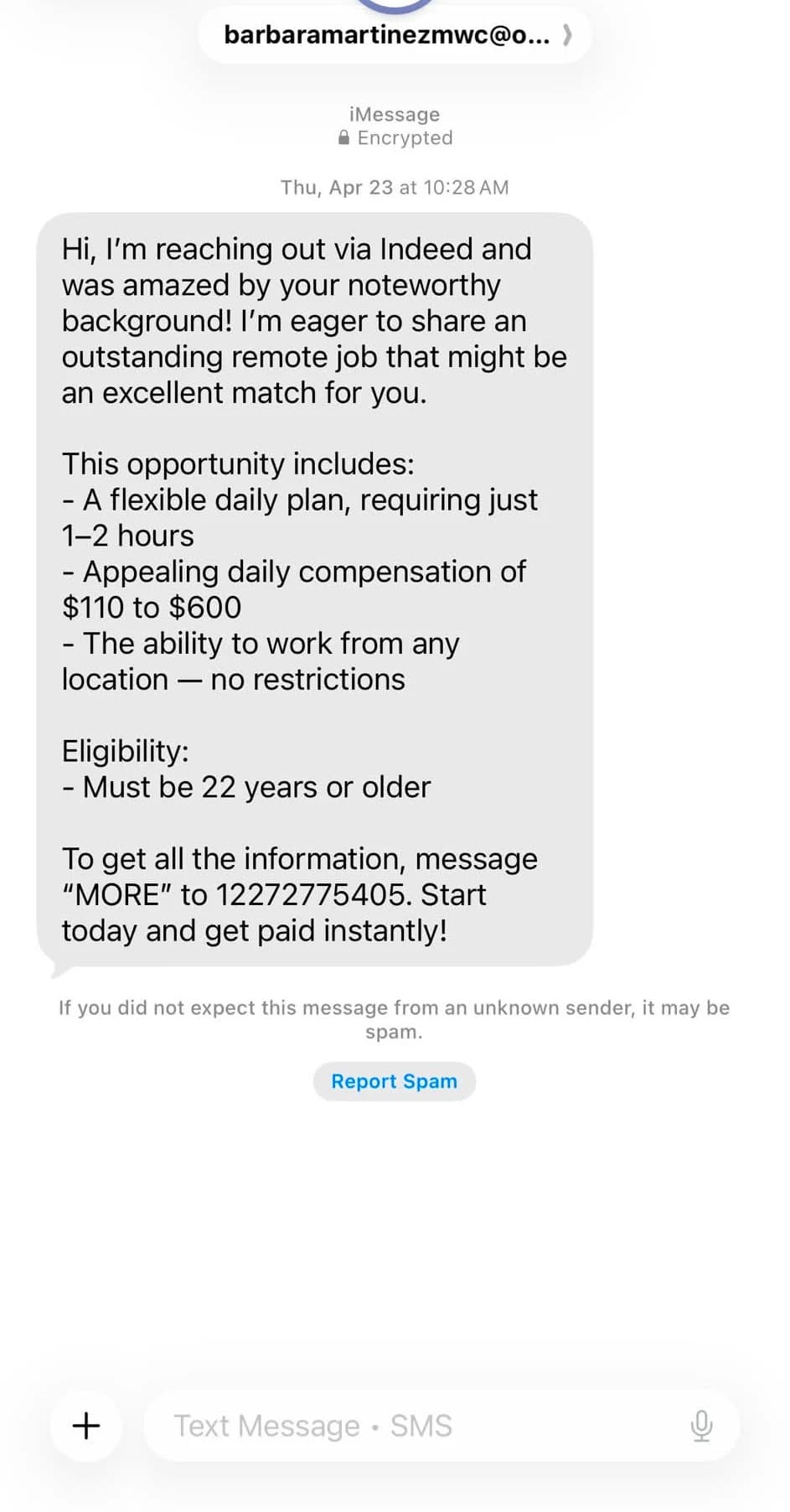
Every message had little information: no company description, no explanation of the work, no hiring manager, no application process. Just a promise of impressive daily pay and the suggestion that almost anyone qualified. Legitimate recruiters don't typically lead with a salary while telling you virtually nothing about the role.
The FTC says this is a growing scam
According to the Federal Trade Commission, scammers are increasingly impersonating recruiters from legitimate companies, advertising remote jobs with attractive pay. Many claim they're hiring for roles like "online assessor" and ask recipients to reply with "YES" or "INTERESTED" to start a conversation.

The scam usually escalates: victims may be told to deposit a check and send money back—a classic fake check scam—or to complete simple tasks like rating products before being asked to deposit their own money to "unlock" earnings. The BBB has seen fraudsters lure people into watching or liking videos, then pressure them into sending cash that disappears.
A few red flags stood out immediately
- The texts were completely unsolicited.
- The pay seemed unrealistically high for minimal qualifications.
- There was no meaningful information about the employer or role.
- Asking for a simple "YES" reply felt more like marketing than recruiting.
Each red flag alone might not seem definitive. Together, they painted a clear picture.
How to protect yourself

The FTC recommends ignoring unexpected job offers via text, WhatsApp, or Telegram. Legitimate employers don't recruit complete strangers that way. And remember: you should never have to pay money to get a job or to get paid. If someone asks you to deposit a check, send money back, purchase equipment, or invest your own funds, walk away.
I still receive these texts occasionally. Now, instead of wondering whether to respond, I simply delete them. If a job sounds vague, promises hundreds a day with no qualifications, and arrives out of nowhere via text, it's probably exactly what it looks like: a scam.
- #remotejobscams
- #work-from-homefraud
- #employmentscams
- #cybersecurity
- #jobsearchredflags
Comments · 0
No comments yet
Be the first to share your thoughts and start the conversation.