
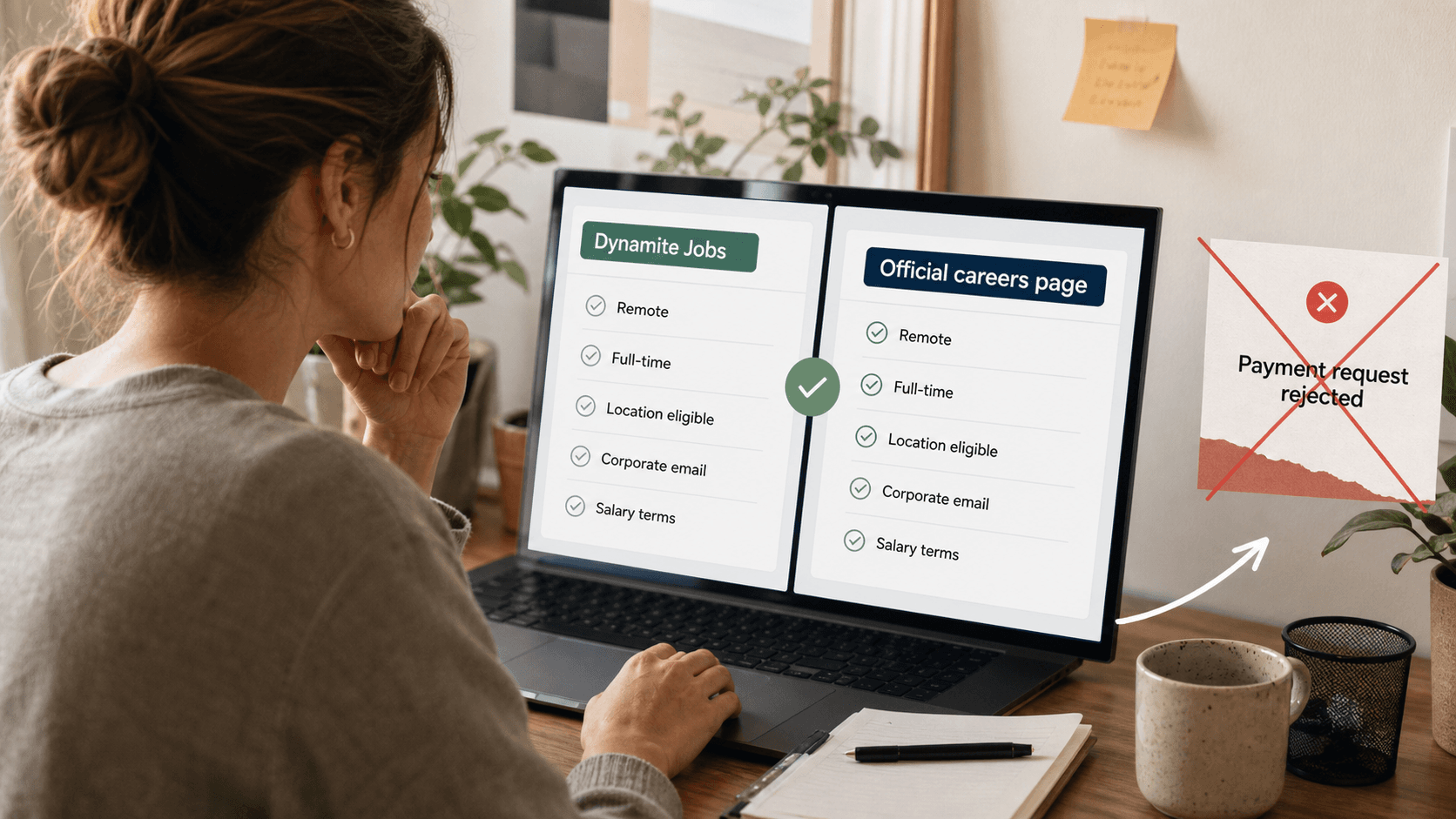
To find a verified remote job in July 2026, use specialist boards as discovery tools, then confirm every vacancy through the employer’s own website before sharing sensitive information. Dynamite Jobs’ July listings were updated on July 25 and describe the platform’s focus on remote-first employers and 100% work-from-home roles. Virtual Vocations also published an employer-partner openings update on July 22, covering fresh remote positions across several industries.
The safest workflow is to shortlist a role, identify the hiring company, find the same vacancy through an official careers page, verify the recruiter and interview process, and apply without paying money. For U.S. federal roles, use USAJOBS. For scam detection, the Federal Trade Commission advises that legitimate employers do not ask candidates to pay to get a job, deposit a check and return part of the money, or send money for online tasks.
What “verified remote” should mean in practice
“Verified” is useful only when you define the word precisely. A credible listing should identify a real employer, describe a specific job, state the employment arrangement, and provide an application route that can be connected to the company’s official domain. A board’s moderation or vetting may improve the starting point, but it cannot replace your own verification.
Dynamite Jobs says it works with remote-first employers offering 100% work-from-home jobs. Its July 25 page displayed roles including a Senior Full-Stack Engineer, Director of Operations, Product Manager, Staff Software Engineer, and Enterprise Account Executive, with employment type, compensation information, skills, and posting-age indicators shown for the listings. Treat these entries as time-sensitive leads rather than guaranteed availability.
Virtual Vocations is useful for a different reason: its July 22 employer-partner update groups current openings by employer and publication date. The page listed roles such as a Remote Administrative Scheduler from Paragon Planners, a Media Search Analyst from TELUS Digital, and healthcare customer-service positions from TTEC.
Best platforms for a July 2026 remote-job search
Use platforms for different stages of the search instead of treating them as interchangeable job databases.
- Dynamite Jobs: best for a concentrated search of remote-first roles. Its visible categories include developer and engineering, management and operations, administration, marketing, writing, and sales.
- Virtual Vocations: best for structured searches across employers and professions. Its July update is particularly useful for seeing which employer-partner roles were being promoted during the month.
- USAJOBS: best for U.S. federal employment. The individual announcement remains the authority for remote eligibility, location, qualifications, and application deadlines.
- Employer career pages: best for final confirmation. Search the company name and role title independently, check whether the opening appears in the company’s applicant-tracking system, and compare the contact details.
General professional networks can also help, but they demand more verification because impersonators may copy legitimate company names and job descriptions. A specialist board is therefore a useful filter, not a substitute for checking the employer directly.
How to verify a listing before you apply
Verification should happen before you upload identity documents, complete tax forms, or provide banking information. Work through the same sequence for every promising role.
- Record the exact job title, employer, compensation language, location requirement, and listing date.
- Open a new browser tab and find the employer’s official website without relying only on the link supplied by a recruiter.
- Search the company’s careers page for the same title or requisition number. A different title is not automatically suspicious, but ask why the details differ.
- Check that the recruiter’s email domain matches the employer’s genuine website and that the contact can be independently verified.
- Confirm the working arrangement. “Remote” may mean remote within one country, state, or time zone, or it may include occasional office attendance.
- Compare duties, pay range, seniority, employment type, and application instructions across the board and employer pages.
- Apply through the company’s official system where possible, and keep a copy of the vacancy and correspondence.
A useful distinction is between identity verification and job verification. A recruiter can have a real name and still be contacting you about a fake opening. The vacancy itself must exist in a channel controlled by the employer.
How to read current remote listings without overestimating them
Remote-job boards often make search efficient, but the headline rarely contains the most important constraint. Read the location, time-zone, travel, equipment, payroll, and contract sections before deciding that a role fits.
A listing marked “100% remote” may still be limited to candidates in a specific country because of payroll, tax, data-protection, or employment-law requirements. A role advertised in U.S. dollars may be contractor work rather than salaried employment. A monthly figure may not include benefits, paid leave, taxes, or currency-conversion costs.
The July Dynamite Jobs page shows why the full detail matters: its featured roles combine full-time positions with different salary formats, including monthly and annual figures, and cover marketing, sales, operations, product, and software work. Use the public information to decide whether to investigate further, not to assume that the highest displayed number is the likely offer.
Before applying, write down your non-negotiables:
- country or state eligibility;
- employee, contractor, freelance, or temporary status;
- minimum compensation and currency;
- required working hours and time-zone overlap;
- equipment and connectivity expectations;
- travel, on-call, or occasional office requirements;
- language, licensing, or work-authorization rules.
How to avoid fake recruiters and payment scams
The FTC says scammers advertise jobs through online ads, job sites, social media, and direct messages while seeking money or personal information. In an April 2026 alert, the agency described fake recruiters who offered generic remote roles by text, WhatsApp, or Telegram and sometimes asked recipients to reply “YES” or “INTERESTED.”
The same FTC guidance warns that scammers may send a check for equipment or an apparent overpayment and then ask the recipient to return part of the money. A check can appear to clear before the bank discovers that it is fraudulent, leaving the victim responsible for the withdrawn funds.
Stop the process immediately if a recruiter:
- asks for an upfront fee, paid training, a “refundable” deposit, or cryptocurrency;
- sends a check for equipment and asks you to buy items or return the balance;
- insists on gift cards, wire transfers, or payment-app transfers;
- contacts you unexpectedly with a generic job description and pressures you to respond immediately;
- requests a Social Security number, passport scan, bank details, or direct-deposit form before a genuine offer and normal onboarding;
- discourages you from contacting the employer directly.
Do not confuse a normal background check or payroll form with an early request for sensitive data. Timing and channel matter. Provide necessary information only after you have independently confirmed the employer, completed a credible selection process, and understand who will store and use the data.
How to turn a listing into a stronger application
Remote hiring rewards evidence of independent execution, written communication, and reliable collaboration. Tailor your resume to the actual work described instead of adding “remote” as a keyword without proof.
For operations, support, marketing, and content roles, describe outputs such as documented processes, campaign assets, customer-resolution workflows, editorial calendars, or reporting routines. For technical roles, connect tools and languages to shipped work, maintained systems, testing, security, or measurable improvements. If the vacancy mentions asynchronous work, show examples of clear documentation, handoffs, decision records, and communication across time zones.
A concise application can answer three questions:
- Which requirement do you satisfy most clearly?
- What evidence demonstrates that capability?
- Why does your experience fit this employer’s working model?
Do not claim experience you cannot document. If you are changing fields, use a conditional example honestly: you might explain how a portfolio project demonstrates the same workflow, while distinguishing it from paid employment.
What to do after submitting an application
Keep a simple application log with the employer, role, URL, date, recruiter, expected next step, and any information you provided. This prevents duplicate applications and helps you detect inconsistent messages if different people claim to represent the same company.
When a recruiter contacts you, independently verify the person through the company website or a known corporate switchboard. Reply using a channel you found yourself rather than relying exclusively on a message link. A legitimate employer should be able to explain the role, reporting line, location restrictions, interview stages, and compensation structure without asking you to send money.
If you suspect fraud, stop communicating, preserve emails and screenshots, contact your bank or payment provider if money was sent, and report the incident to the platform and the FTC.
Your practical July 2026 search plan
Start with two focused searches on Dynamite Jobs and Virtual Vocations, then add USAJOBS if U.S. federal employment is relevant. Save only roles that match your location, work status, schedule, and skills. For each one, complete the employer-site verification before sending sensitive information.
As of July 26, 2026, the most reliable signal is not a promise of easy work or unusually fast hiring. It is a consistent chain from a current listing to a real employer, a normal application process, a verifiable recruiter, and written terms that match what you were shown. Use that chain as your minimum standard, and let the quality of the role—not the urgency of the message—decide whether you proceed.


Comments
No comments yet
Be the first to share your thoughts and start the conversation!